
Camp Nakanawa has had exactly four directors in over a hundred years.
Colonel Rice founded camp in 1920 and led it until 1947. Elisabeth “Mitch” Mitchell followed, directing Nakanawa for more than thirty years. And in 1981, Mitch asked her niece Ann, alongside Ann’s husband Pepe, to take on the role themselves. Ann had grown up at camp, starting Junior Camp at age 12 and later chosen Lady of the Cup in 1967. Pepe came from a poultry family in Gainesville, Georgia. They were both just 30 years old when they said yes.
Ann and Pepe led Camp Nakanawa for the next 41 years. In 2022, camp transitioned to a non-profit, and they retired.
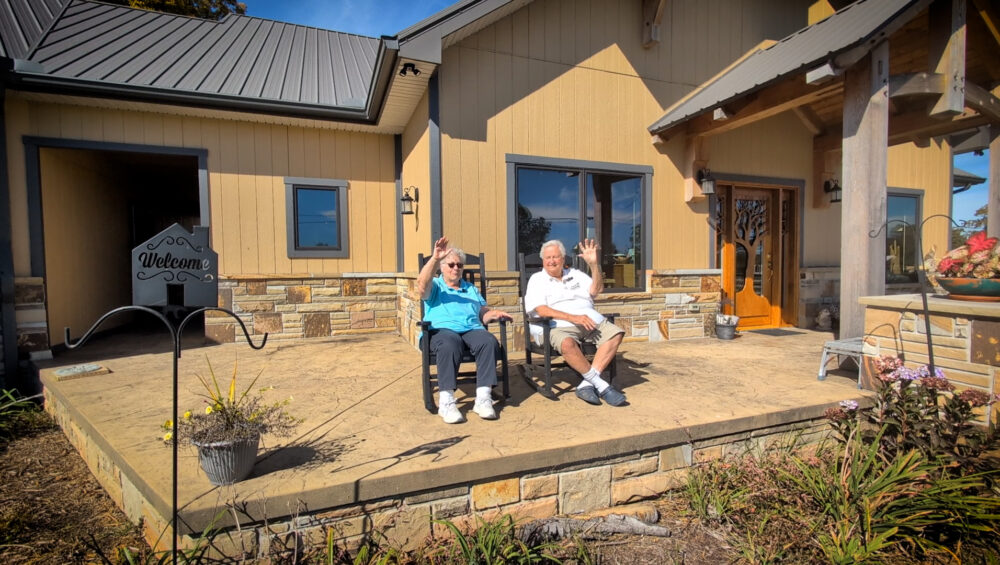
They didn’t go far. On the same 1,000 acres where they spent four decades building girls into who they are, Ann and Pepe built a home of their own. They call it Meadowview Lodge.
The Plan on a Napkin
There was no architect, no blueprint pinned to a drafting table. The whole house started as a sketch on a napkin, drawn in the back of the camp dining hall.
“We had a plan that we made on a napkin,” Ann says. “We drew it in the back of the dining hall, and we took that with us.”
Built From the Same Ground
The fireplace came first in their thinking. “We wanted a fireplace similar to the big house,” Ann explains, “because we love that fireplace, and it’s real special to be able to sit on the hearth.”
They found their stone close to home. Crab Orchard stone is native to the county, and Larry Kilby, a stonemason who lives just down the road in Mayland, specializes in it. He built the Meadowview fireplace and laid Crab Orchard stone across the whole exterior of the house. It wasn’t Kilby’s first project for Ann and Pepe. He’d also laid three or four hundred tons of the same stone at the Crow’s Nest, for camp’s Centennial.
The stone means something older than that, too. Pepe grew up in a Crab Orchard stone house himself, back in Gainesville. “My father got it from up here by the boxcar,” he says. “He had special masons come in, because everybody was used to bricks, they’re all the same size, and Crab Orchard stone is all different. So stone was important for my past, and our present, here at camp.”
Above the living room, the ceiling is timber frame, Douglas fir shipped in and assembled at the builder’s shop, then taken apart again and reassembled on site, joined the old way, with wooden pegs instead of nails.
Even the porch floor was a decision rooted in camp. “We didn’t want a wooden porch,” Pepe says. “It’s the same with Egypt. We wanted the concrete.” Any alumna who remembers camp’s bathhouse will recognize exactly what he means.
The Door That Took 45 Years
The front door has its own story, and it starts decades before the house did.
Ann and Pepe had seen a door they loved roughly 45 years ago, long before they had a house to put it on. They kept the idea in the back of their minds. When it finally came time to build, they asked the timber frame company if they knew anyone who could build a custom door. The answer was yes: a Mennonite craftsman named Mr. Weaver, living in Spencer, Tennessee. He doesn’t drive, and he does extraordinary work by hand. Told what they had in mind, he said he thought he could do it in six months.
He did. A driver brought him and the finished door to Meadowview when it was ready.
The Everyday Things
Not everything about Meadowview is a grand story. Some of it is just the small, specific comfort of a house built by people who knew exactly what they wanted.
Ann loves the kitchen sink, a big farmhouse sink, sunk down into the counter. “It’s wonderful,” she says. “It’s really nice.”
For Pepe, the most important feature isn’t visible at all: accessibility. Wide double doors open straight onto the back porch, and the whole house is built to be handicap-compliant. “People can come here,” he says, “and it’s handicap-compliant, so we don’t have to worry.”
There’s also a quieter kind of legacy built into the garden. A young buckeye tree grows near the fence, a nod to a mentor of Pepe’s who was given a buckeye as a girl starting her career at a Gainesville bank, and who stayed there nearly fifty years. Buckeyes are said to bring good luck. “She taught me those,” Pepe says, “as I grew up along the way.”
And elsewhere around camp, 112 solar panels do their own quiet work. Together, they produce roughly 45 percent of the electricity that Camp Nakanawa itself uses.
What the Tree on the Door Means
The last detail is the one that says the most.
Carved into the front door is a tree. Its branches, Pepe explains, are symbolic: the different branches of their lives, the things they did along the way. And the leaves, if the tree were full of them, would be the children they hope they had a positive effect on, all along the way.
Forty-one years of campers walked through Nakanawa’s gates under Ann and Pepe’s watch. Now, every one of them walks past that tree, carved into a door that took 45 years to imagine and six months to build, every time they come to see the two people who built it.
Welcome to Meadowview Lodge.
3 Comments
Happy for Ann and Pepe that they get to live out their lives in beautiful Meadowview Lodge. It is so well thought out and personalized, and I pray that it will be a blessing to them. Thank you, Ann and Pepe for blessing all your campers at Camp Nakanawa for so many years.
You are well loved,
Margot Kepper Berry
Ann and Pepe, thank you for all the years of service and love you have given Nakanawa and all the lives you touched! I only spent one summer at Nakanawa as a counselor but it impacted my life tremendously. In one summer I was privileged to work with both Mitch and Ann. I’m thrilled to know that you were able to build your dream home there and live out your retirement years there after giving a lifetime of service at Nakanawa! Well done and Congratulations!
Dorinda (Dorie, 1977, Art and Softball Counselor)
What a beautiful story—every detail of this house feels like it was chosen with so much intention and love. The fact that it started as a sketch on a napkin in the back of the dining hall is such a fitting origin for a home built by two people who spent decades shaping camp life. I love that the stone for the fireplace came from the same county, and that Pepe’s connection to Crab Orchard stone goes all the way back to his childhood home. It’s like the house is rooted in the land and in memory at the same time.
The front door story really got me—imagining a door for 45 years before you even have a house to put it on, and then waiting six months for a craftsman to build it by hand. That kind of patience and vision is rare. And the tree carved into it, with branches representing their lives and leaves representing the campers they influenced, is such a moving tribute to their legacy. Every time I walk through a camp gate, I think about the generations of campers who’ve passed through before me, and this door seems to capture that feeling perfectly.
My question is about that transition from directing camp to building this home on the same grounds: after 41 years of running Camp Nakanawa, what has it been like to shift from being the directors who were responsible for everything to simply being neighbors on the property? Do you find yourselves still involved in camp life, or has Meadowview become a place of quiet retreat and separation from the rhythms of camp?